Loading...
Skill 1 of 6
Angles
Find missing angles on a line, at a point, and in a triangle.
About 12 min
The idea
An angle measures the turn between two lines that meet at a point. The point is the vertex. Angles are measured in degrees (°).
A full turn is 360°. A straight line is half a turn: 180°. A square corner is a quarter turn: 90°. That is a right angle, marked with a small square.
- An acute angle is less than 90°.
- An obtuse angle is more than 90° and less than 180°.
Most missing-angle problems use one of four totals: 90° for a right angle, 180° for a straight line, 360° for a full turn, and 180° for the angles of a triangle. Add the angles you know, then subtract from the total.
Angles on a straight line
Two angles that sit together on a straight line add to 180°. If one is 130°, the other is 180 − 130 = 50°.
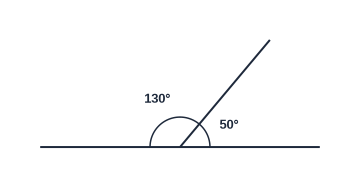
The same works for a right angle split in two: the parts add to 90°. If one part is 28°, the other is 90 − 28 = 62°.
Angles around a point
Angles that go all the way around a point add to 360°. Three angles of 100° and 120° and an unknown: 100 + 120 = 220, and 360 − 220 = 140°.
A clock face is a full turn split into 12 equal parts, so the hour marks are 360 ÷ 12 = 30° apart.
Two lines that cross
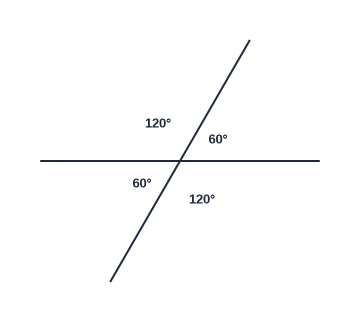
When two straight lines cross, they make four angles. The angles directly across from each other are equal. Angles side by side sit on a straight line, so they add to 180°.
Angles in a triangle
The three angles of any triangle add to 180°. Tear off the three corners of a paper triangle and line them up: together they fill a straight line.
If two angles of a triangle are equal and the third is 40°, the equal angles share 180 − 40 = 140°, so each is 70°.
A four-sided shape splits into two triangles along a diagonal, so its four angles add to 2 × 180 = 360°.
A common mistake
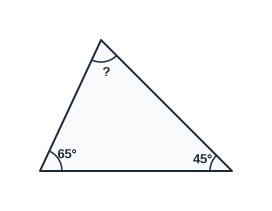
Using 360 for a triangle. With angles of 65° and 45°, 360 − 110 gives 250°.
An angle of 250° is more than a straight line, so it cannot fit inside a triangle. 360° is a full turn around a point. The three angles of a triangle fit on a straight line, so they add to 180°: 180 − 110 = 70°.
Key points
- Angles are measured in degrees. A full turn is 360°, a straight line is 180°, and a right angle (a square corner) is 90°.
- An acute angle is less than 90°. An obtuse angle is between 90° and 180°.
- Angles that sit together on a straight line add to 180°. Angles around a point add to 360°.
- When two lines cross, the angles directly across from each other are equal.
- The three angles of a triangle add to 180°. The four angles of a four-sided shape add to 360°.
Worked example
Worked Example: A triangular garden bed
Problem
A triangular garden bed has two corners that measure 65° and 45°. What is the angle at the third corner?
Solution
- 1The bed is a triangle, so its three angles add to 180°.
- 2Add the two angles you know: 65 + 45 = 110.
- 3Subtract from 180: 180 − 110 = 70. The third corner is 70°.
- 4Check: 65 + 45 + 70 = 180. The third corner is less than 90°, so it is acute.
Answer
70°