Loading...
Skill 2 of 6
Perimeter and area
Find the perimeter and area of rectangles, triangles, and other shapes.
About 14 min
The idea
Perimeter is the distance around a shape. Add the lengths of all the sides. Perimeter is a length, so it is measured in units such as feet or meters.
Area is the space inside a shape: the number of unit squares that cover it. Area is measured in square units, such as square feet.
For a rectangle, area = length × width. A triangle is half of a rectangle, so its area = ½ × base × height. The height is measured straight up from the base, at a right angle to it.
Squares inside a rectangle
A rectangle 4 units long and 3 units wide holds 3 rows of 4 unit squares: 12 squares. Its area is 4 × 3 = 12 square units.
Area model for 4 × 3: 1 × 1 = 1, 1 × 1 = 1, 1 × 1 = 1, 1 × 1 = 1, 1 × 1 = 1, 1 × 1 = 1, 1 × 1 = 1, 1 × 1 = 1, 1 × 1 = 1, 1 × 1 = 1, 1 × 1 = 1, 1 × 1 = 1; total 12.
111111 × 111 × 111 × 111 × 1111 × 111 × 111 × 111 × 1111 × 111 × 111 × 111 × 11
1 + 1 + 1 + 1 + 1 + 1 + 1 + 1 + 1 + 1 + 1 + 1 = 12
Its perimeter is the distance around the edge: 4 + 3 + 4 + 3 = 14 units. Area counts the squares inside. Perimeter measures the edge.
For bigger numbers, split a side to multiply. A room 12 feet by 10 feet: 10 × 10 = 100 and 2 × 10 = 20, so the area is 100 + 20 = 120 square feet.
Area model for 12 × 10: 10 × 10 = 100, 2 × 10 = 20; total 120.
1021010 × 101002 × 1020
100 + 20 = 120
Triangles
Cut a rectangle from corner to corner and each half is a triangle with the same base and height. That is why the triangle formula has the ½.
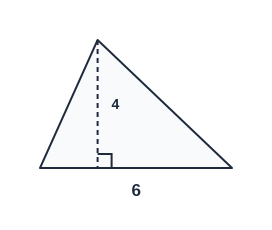
A triangle with base 6 and height 4 has area ½ × 6 × 4 = 12 square units, half of the 6 by 4 rectangle around it. The same is true when the top corner is not above the end of the base: the height is still the straight-up distance.
Other shapes
- Square: all four sides are equal. Area = side × side; perimeter = 4 × side.
- Parallelogram: area = base × height. Slide the slanted end across and it becomes a rectangle. Use the straight-up height, not the slanted side.
- Trapezoid: two parallel sides. Area = ½ × (sum of the parallel sides) × height. A trapezoid with parallel sides 6 and 10 and height 4 has area ½ × 16 × 4 = 32.
- L-shapes: split the shape into rectangles and add their areas, or find the full rectangle and subtract the missing corner. For perimeter, add every side around the outside.
A common mistake
Leaving out the ½ for a triangle. Base 6 times height 4 is 24.
24 is the area of the whole 6 by 4 rectangle. The triangle covers only half of it, so its area is ½ × 6 × 4 = 12 square units.
Key points
- Perimeter is the distance around a shape: add the lengths of all the sides. It is measured in units such as feet.
- Area is the number of unit squares that cover a shape. It is measured in square units such as square feet.
- Rectangle: area = length × width; perimeter = 2 × (length + width). Square: area = side × side; perimeter = 4 × side.
- Triangle: area = ½ × base × height, where the height is measured straight up from the base at a right angle.
- For an L-shape, split it into rectangles and add, or take a missing piece away from a full rectangle.
Worked example
Worked Example: Carpet and baseboard
Problem
A rectangular room is 12 feet long and 10 feet wide. How much carpet covers the floor, and how much baseboard runs around the edge?
Solution
- 1Carpet covers the floor, so find the area: 12 × 10 = 120 square feet (10 × 10 = 100 and 2 × 10 = 20).
- 2Baseboard runs around the edge, so find the perimeter: 12 + 10 + 12 + 10 = 44 feet.
- 3Check the perimeter another way: 2 × (12 + 10) = 2 × 22 = 44.
Answer
120 square feet of carpet and 44 feet of baseboard