Loading...
Skill 5 of 6
Right triangles
Use the Pythagorean theorem to find a missing side.
About 13 min
The idea
A right triangle has one right angle. The two sides that form the right angle are the legs. The side across from the right angle is the hypotenuse. It is always the longest side.
The Pythagorean theorem links the three sides: leg squared plus leg squared equals hypotenuse squared.
Here a and b are the legs and c is the hypotenuse. The theorem works only for right triangles.
Squares on the sides
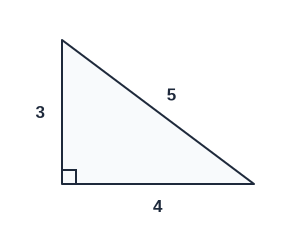
Take a right triangle with legs 3 and 4 and build a square on each side. The square on the 3 side holds 3 × 3 = 9 unit squares. The square on the 4 side holds 4 × 4 = 16.
Area model for 3 × 3: 1 × 1 = 1, 1 × 1 = 1, 1 × 1 = 1, 1 × 1 = 1, 1 × 1 = 1, 1 × 1 = 1, 1 × 1 = 1, 1 × 1 = 1, 1 × 1 = 1; total 9.
11111 × 111 × 111 × 1111 × 111 × 111 × 1111 × 111 × 111 × 11
1 + 1 + 1 + 1 + 1 + 1 + 1 + 1 + 1 = 9
Area model for 4 × 4: 1 × 1 = 1, 1 × 1 = 1, 1 × 1 = 1, 1 × 1 = 1, 1 × 1 = 1, 1 × 1 = 1, 1 × 1 = 1, 1 × 1 = 1, 1 × 1 = 1, 1 × 1 = 1, 1 × 1 = 1, 1 × 1 = 1, 1 × 1 = 1, 1 × 1 = 1, 1 × 1 = 1, 1 × 1 = 1; total 16.
111111 × 111 × 111 × 111 × 1111 × 111 × 111 × 111 × 1111 × 111 × 111 × 111 × 1111 × 111 × 111 × 111 × 11
1 + 1 + 1 + 1 + 1 + 1 + 1 + 1 + 1 + 1 + 1 + 1 + 1 + 1 + 1 + 1 = 16
Together that is 9 + 16 = 25 unit squares, which exactly fill the square on the hypotenuse. The hypotenuse is 5, because 5 × 5 = 25.
Finding a leg
When the hypotenuse is given and a leg is missing, subtract instead of adding. A ramp is 13 feet long and covers 12 feet along the ground. How high does it rise?
13² − 12² = 169 − 144 = 25, and √25 = 5. The ramp rises 5 feet.
When the answer is not a whole number
Legs of 2 and 3 give 2² + 3² = 4 + 9 = 13. 13 is not a perfect square, so the hypotenuse is √13, a little more than 3 (since √9 = 3 and √16 = 4).
A common mistake
Adding the legs. For a ladder with its foot 6 feet from a wall and its top 8 feet up, someone writes 6 + 8 = 14.
14 is the distance along the ground and then up the wall. The ladder goes straight from one end to the other, so it must be shorter. Square the legs, add, then take the square root: √(36 + 64) = √100 = 10 feet.
Key points
- A right triangle has one right angle. The two sides that form it are the legs; the side across from it is the hypotenuse, the longest side.
- Pythagorean theorem: leg² + leg² = hypotenuse², written a² + b² = c². It works only for right triangles.
- Finding the hypotenuse: square the legs, add, then take the square root.
- Finding a leg: square the hypotenuse, subtract the square of the known leg, then take the square root.
- Common whole-number sets: 3-4-5, 6-8-10, 5-12-13, 8-15-17, 7-24-25.
Worked example
Worked Example: How long is the ladder?
Problem
A ladder leans against a wall. Its foot is 6 feet from the wall, and its top reaches 8 feet up the wall. How long is the ladder?
Solution
- 1The wall and the ground meet at a right angle, so they are the legs: 6 and 8. The ladder is the hypotenuse.
- 2Square the legs and add: 6² + 8² = 36 + 64 = 100.
- 3100 is the hypotenuse squared. Take the square root: √100 = 10, since 10 × 10 = 100. The ladder is 10 feet long.
- 4Check: 10 is more than 8, so it is the longest side, and it is less than 6 + 8 = 14.
Answer
10 feet