Loading...
Skill 4 of 6
Volume
Find the volume of boxes, cylinders, and other solids.
About 12 min
The idea
Volume is how much space a solid takes up: the number of unit cubes that fill it. It is measured in cubic units, such as cubic inches or cubic feet.
For a box, volume = length × width × height. That is the area of the bottom layer times the number of layers.
A cylinder works the same way. Its base is a circle with area π × r × r. Multiply that by the height.
Layers of cubes
Start with the base: a rectangle 4 units by 3 units. Its area is 12 square units.
Area model for 4 × 3: 1 × 1 = 1, 1 × 1 = 1, 1 × 1 = 1, 1 × 1 = 1, 1 × 1 = 1, 1 × 1 = 1, 1 × 1 = 1, 1 × 1 = 1, 1 × 1 = 1, 1 × 1 = 1, 1 × 1 = 1, 1 × 1 = 1; total 12.
111111 × 111 × 111 × 111 × 1111 × 111 × 111 × 111 × 1111 × 111 × 111 × 111 × 11
1 + 1 + 1 + 1 + 1 + 1 + 1 + 1 + 1 + 1 + 1 + 1 = 12
Put one cube on each square: one layer holds 12 cubes. Stack a second layer and the box holds 24 cubes. That is 4 × 3 × 2 = 24, the base area times the height.
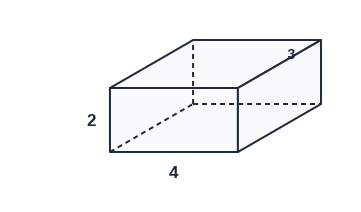
A cube has equal length, width, and height. A cube with edges of 3 has volume 3 × 3 × 3 = 27.
Cylinders
A cylinder is a stack of circles. Find the area of the circular base, then multiply by the height.
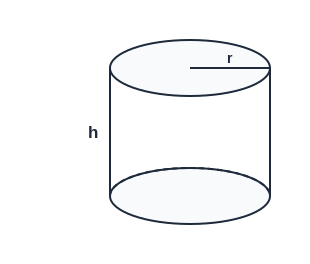
A can with a radius of 4 inches and a height of 5 inches: base area π × 4 × 4 = 16π, and volume 16π × 5 = 80π cubic inches. If the problem gives a diameter, halve it to get the radius first.
Other solids
Two more formulas cover the solids you are likely to meet:
- Sphere (a ball): volume = × π × r × r × r. A ball with a radius of 3 has volume × π × 27 = 36π.
- Cone: volume = × π × r × r × h, one-third of the cylinder with the same base and height.
A common mistake
Adding the measurements. For a tank 20 inches long, 10 inches wide, and 12 inches tall, someone writes 20 + 10 + 12 = 42.
42 cubes would not even cover the bottom of the tank: the bottom layer alone holds 20 × 10 = 200 cubes. Volume multiplies the three measurements.
Key points
- Volume is the number of unit cubes that fill a solid. It is measured in cubic units, such as cubic inches.
- Box: volume = length × width × height, which is the area of the base times the height.
- Cube: all three measurements are equal, so volume = side × side × side.
- Cylinder: volume = π × radius × radius × height (base area πr² times the height).
- Volume multiplies the three measurements. Adding them, or stopping at the base area, gives the wrong answer.
Worked example
Worked Example: Filling a fish tank
Problem
A fish tank is 20 inches long, 10 inches wide, and 12 inches tall. How many cubic inches of water fill it?
Solution
- 1Find the area of the base: 20 × 10 = 200 square inches. One layer holds 200 cubes.
- 2The tank is 12 inches tall, so there are 12 layers: 200 × 12 = 2,400 cubic inches.
- 3Check by multiplying in a different order: 10 × 12 = 120, and 120 × 20 = 2,400.
Answer
2,400 cubic inches